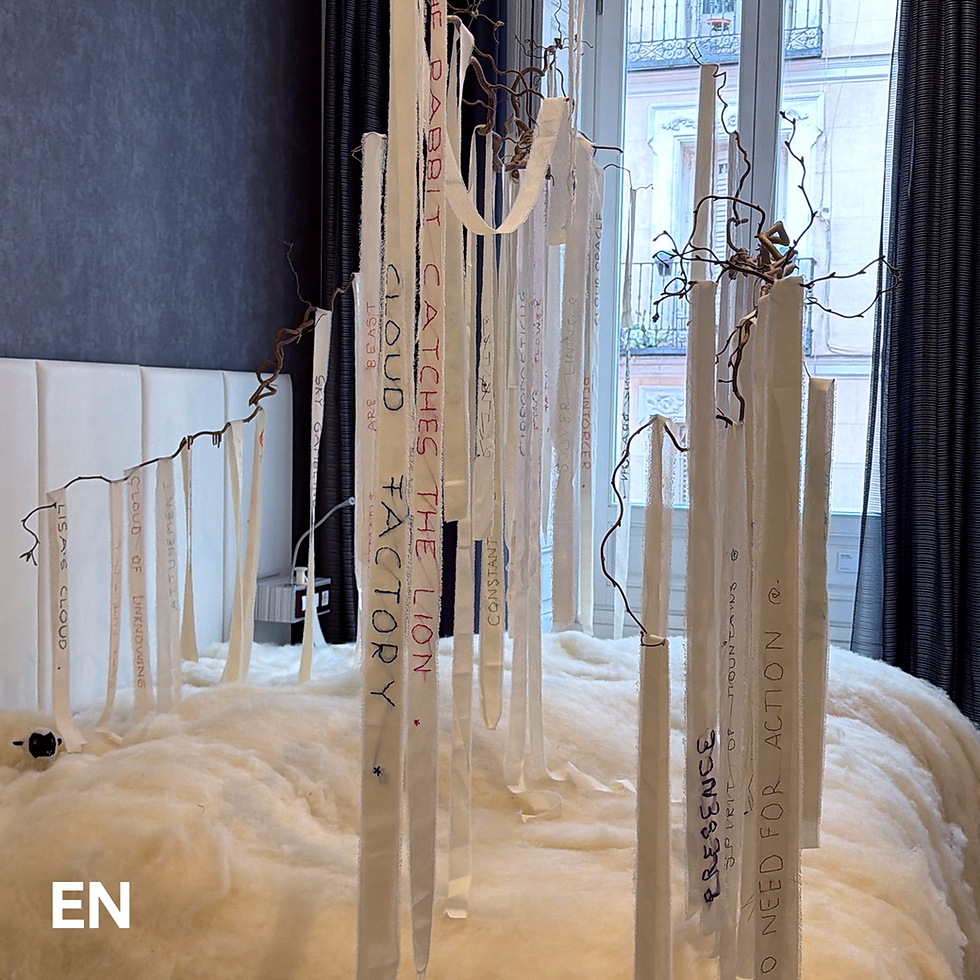
(EN) After the Exhibition / Hybrid Art Fair, Madrid, 2026

Updated: Apr 28

Poetic Clouds: On Clouds, Becoming, and Co-Creation
Poetic Clouds is not merely an exhibition; it emerged as an arts-based research practice that unfolded over time, shaped through encounters, and continuously transformed throughout the creative process. Rather than applying a predefined conceptual framework, the work is grounded in an experience that arose from within the process itself and revealed itself step by step.
As a psychotherapist and researcher in the field of Expressive Arts, my approach to this process is not centered on representing knowledge, but on creating space for it to emerge from within the act of creation—through embodied, sensory, and imaginal ways of knowing. In this sense, Poetic Clouds can be understood not as a result, but as a process; not as a fixed narrative, but as a space that is co-created and continuously reshaped.
Cloud as a Field of Encounter
The starting point of this process emerged from an everyday yet profound experience.
During the time Andrea and I spent in Saas Fee, in the Swiss Alps, clouds were a constant presence. As they touched the mountains, shifting form—gathering and dissolving—they became more than a visual phenomenon; they turned into a practice of pausing, looking, and re-sensing meaning.
Looking at the same sky again and again, each time perceiving something different—and sensing its resonance within—transformed clouds from a metaphor into a field of inquiry.
In this context, the cloud was approached not as a representational object, but as a space of encounter between the inner and the outer. As Marcel Proust suggests, clouds can be understood as “figures of projection”—ephemeral mirrors that reflect back personal memories, emotions, and inner images.
Slowing Down, Gaze, and Embodied Experience
Poetic Clouds was conceived as an invitation into radical deceleration.
This space opens a state of non-doing, where the speed and demands of the world are momentarily suspended, allowing for a more attentive and contemplative presence. In this state, the gaze expands upward; the sky is no longer a distant object but becomes a relational field between the internal and the external.
Here, looking shifts from a passive act into a process of mutual shaping. As the viewer projects their inner images onto the clouds, the ever-changing nature of the sky begins to contour their own presence.
In this way, the viewer moves beyond the role of an observer and becomes part of the experience—a co-dreamer.
Co-Creation and Intermodal Flow
As the process unfolded, the visual and poetic dialogue between Andrea and me evolved into an intermodal field of creation.
While Andrea’s cloud imagery and poetic language carried the experience into words, I developed an embodied response through movement. Through breath, rhythm, and gesture, a performative process emerged that responded to the transience and transformation of clouds.
At this point, creation shifted from a one-directional act of expression into a space of reciprocal listening and responding.
This reciprocity gave rise to a co-creative process at the core of the work.
Over time, different modalities—poetry, movement, sound, video, and glass—interwove into a dynamic flow. This process reflects a central principle of Expressive Arts: that meaning deepens through the transition from one form to another.
Material, Body, and Transformation
The organic materials that emerged in the process—wool, cotton, and tree branches—became not only aesthetic elements but carriers of experience.
Hand-blown glass forms appeared as “crystallized clouds,” holding moments at the intersection of air and matter. These forms embody the tension between solidity and vapor, making transformation itself visible.
At this point, the role of the body became central. Breath, movement, and sensory experience revealed that our relationship to the sky is not only visual, but deeply embodied.
Impermanence and Becoming
Drawing on the wisdom of Thich Nhat Hanh, the work approaches impermanence not as loss, but as a fundamental condition of existence.
A cloud never truly disappears; it simply transforms—into rain, mist, or even the breath we exhale.
From this perspective, every dissolution is not an ending, but the threshold of a new beginning.
Poetic Clouds as a Field of Becoming
In this sense, Poetic Clouds can be understood less as an installation and more as a “field of becoming.”
A sensory environment where inner images, bodily sensations, and relational encounters intersect—and where the viewer becomes an active participant in the process.
This is not something to be merely observed, but something to be experienced, felt, and continuously re-created through each encounter.
In the next text, I will return to this process from within my position as an artist, and share how I experienced and made sense of it through the concepts of Expressive Arts.